
Why I Wrote The Decision Maker’s Handbook
LEADERSHIP MASTERYFEATURED
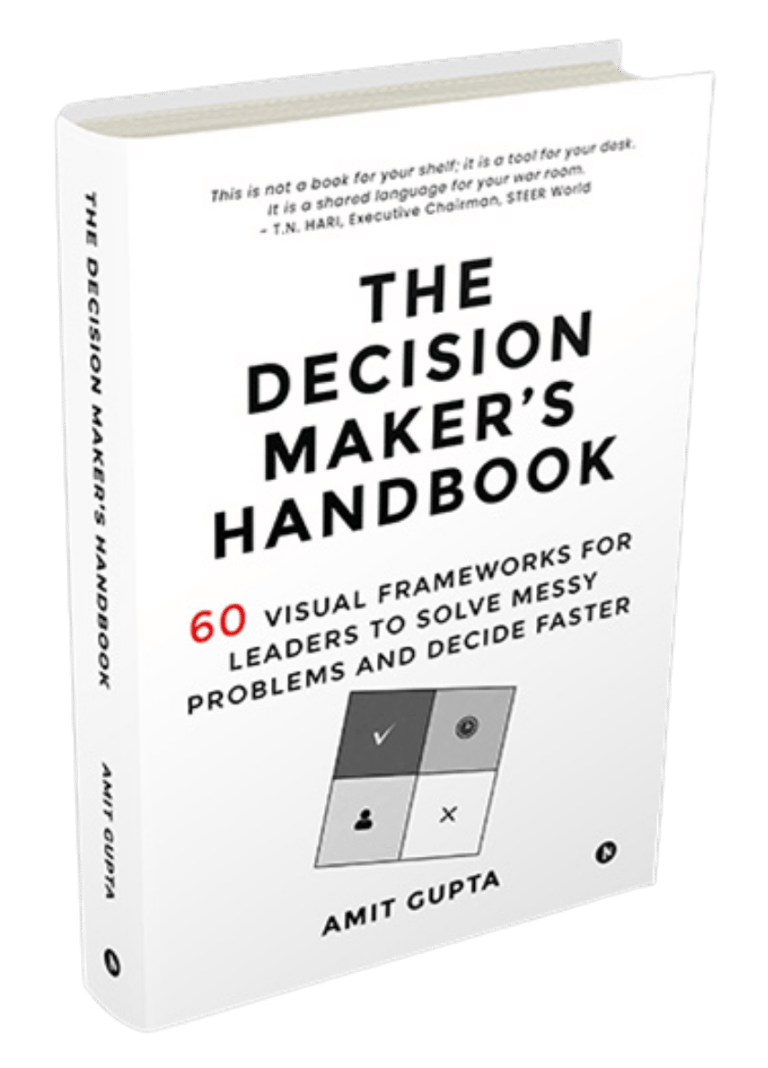
For a long time, I thought my tendency to overthink decisions was simply part of who I was.
In leadership roles, careful thinking often feels responsible. After all, decisions affect people, teams, customers, outcomes, and sometimes entire organizations. But over time, I started noticing something else. Thoughtful leadership can quietly turn into hesitation, delayed execution, and mental exhaustion when clarity never feels “good enough.”
This realization, along with years of leadership experience, coaching conversations, and operational challenges, eventually became the seed for The Decision Maker’s Handbook.
For a long time, I thought I was simply an overthinker.
Not in the dramatic sense. More in the everyday leadership sense.
The kind where you keep replaying scenarios in your head before making a decision. The kind where you instinctively look for more information, another perspective, one more data point, or a little more certainty before moving forward.
In many ways, that instinct helped me.
Over the years, I’ve worked across leadership, operations, customer experience, outsourcing, coaching, and organizational growth. In those environments, decisions matter. Sometimes a lot. Teams move based on them. Customers feel the impact of them. Businesses grow... or struggle, because of them.
And when you’re the one carrying responsibility, decisions are rarely just intellectual exercises. They carry consequences, trade-offs, uncertainty, and at times, emotional weight.
What surprised me over time was how mentally exhausting decision-making can become.
Not because every decision is huge or life-changing. But because leadership often means living in a constant stream of incomplete information, competing priorities, operational realities, people concerns, and the pressure to keep things moving forward.
I’ve sat in meetings where capable teams slowed down simply because a decision stayed unresolved for too long.
Not because people were incompetent.
Not because they didn’t care.
But because everyone was waiting for more clarity.
And, I’ve been part of that too.
There were moments when I kept analyzing, evaluating, gathering inputs, hoping that eventually the “perfect answer” would become obvious. As if certainty would quietly walk into the room and remove all doubt.
The problem is... real life rarely works that way.
At some point, even delayed decisions become decisions.
What helped me gradually change my approach were not massive theories or complicated business models. It was often much simpler than that.
A few 2x2 practical frameworks.
A few mental models.
A few questions that helped cut through noise and bring clarity to the next step.
Over time, I started holding onto these tools almost like a personal ready reckoner for different situations:
when information was incomplete,
when emotions were running high,
when urgency was real,
when every option felt imperfect,
or when overthinking had started disguising itself as productivity.
Realization - I am not alone
As I began coaching leaders, founders, and business owners, I realized how common this struggle actually was.
So many smart, capable people quietly carry the burden of decision fatigue.
Not because they lack intelligence or experience.
Often the opposite.
The more responsibility people carry, the more carefully they tend to think. The challenge is that thoughtful leadership can sometimes drift into hesitation, analysis paralysis, or delayed execution without us even realizing it.
That realization stayed with me for a long time.
And slowly, the idea for The Decision Maker’s Handbook began taking shape.
I didn’t want to write a book full of abstract theories or complicated frameworks that only sound impressive in conference rooms and PowerPoint presentations.
I wanted to create something practical.
A thinking companion for people navigating uncertainty, complexity, pressure, growth, and everyday leadership realities.
A book people could return to when they felt stuck.
When clarity was missing.
When the path forward felt messy.
When action mattered more than perfect certainty.
In many ways, writing this book also became a personal reflection journey for me.
Because the truth is, decision-making is not only about strategy or logic. It is also about self-awareness, courage, timing, judgment, priorities, and learning to move forward even when complete certainty is unavailable.
Maybe that is one of the quieter realities of leadership that we do not talk about enough.
Most meaningful decisions in life are made before we feel fully ready.
And perhaps growth is not about eliminating uncertainty altogether.
Perhaps it is about learning how to navigate it with greater clarity, awareness, and intention.
That, more than anything else, is why I wrote The Decision Maker’s Handbook.
Related Stories
Amit-Gupta.Online © 2024
My purpose is to unleash human potential and democratize access to economic, social, and personal success.
Leadership. Decisions. Systems. Growth.
Join me for occasional insights and ideas worth thinking about.